THE DESK ARCHIVE
CURATED ANSWERS TO ARTISTS MOST PRESSING QUESTIONS
Each quarter, we publish the 15 most relevant questions from artists—answered in full. Download the latest edition below.
Pricing, collectors, AI, studio space, burnout, and more. All answers grounded in market research and written for artists.
free download
THE DESK · Q1 2026
Inaugural edition · 15 answers · 19 pages
—
All inquiries confidential. No obligation.

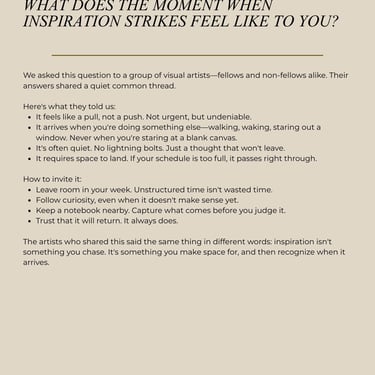
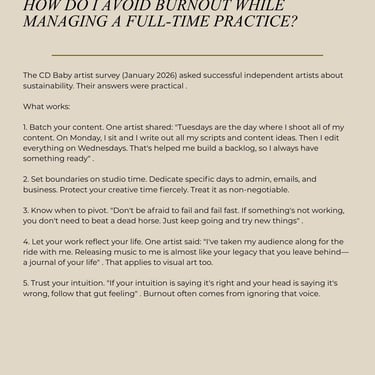
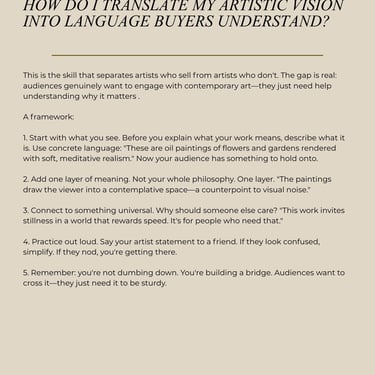
Q1 Preview
This is a preview. The full document is available for download above.
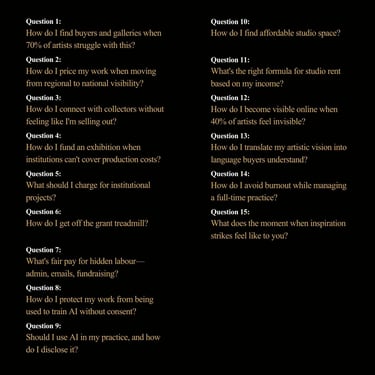
Each quarter, our team selects the 15 most relevant questions from artists—based on frequency, urgency, and universal appeal. Every answer is written in plain language, grounded in market research, and designed to be immediately useful.
There's no login, no email required, no hidden agenda. Just answers.
INFO
HOW IT WORKS
—
All inquiries confidential. No obligation.
Q: How do I price my work when I'm moving from regional to national visibility?
This is the most common question we receive, and the answer is never just a number. Pricing is a signal. If you jump too fast, you scare off existing collectors. If you move too slowly, you leave money on the table and signal that you don't believe in your own trajectory.
The artists who navigate this well do three things:
1. They benchmark against peers, not heroes. Find five artists with similar career stages (exhibition history, press, collection depth) in your medium. See where their prices sit. That's your corridor.
2. They raise prices with new bodies of work. Never raise on existing inventory. When you unveil a new series, that's the moment to step up. It gives collectors a reason for the increase—the work itself has evolved.
3. They communicate the why. When a long-time collector asks about a price increase, they say: "This body of work represents a year of research and a shift in my practice. The pricing reflects that evolution, and I'm grateful for your continued support."
Pricing is a story. Tell it clearly.
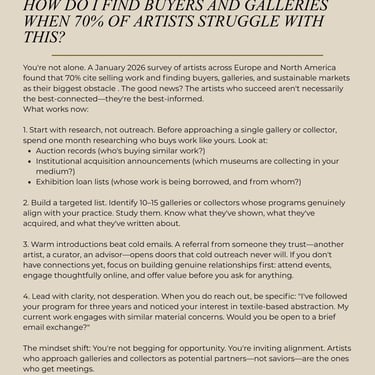
Question 1: How do I find buyers and galleries when 70% of artists struggle with this?
You're not alone. A January 2026 survey of artists across Europe and North America found that 70% cite selling work and finding buyers, galleries, and sustainable markets as their biggest obstacle . The good news? The artists who succeed aren't necessarily the best-connected—they're the best-informed.
What works now:
1. Start with research, not outreach. Before approaching a single gallery or collector, spend one month researching who buys work like yours. Look at:
Auction records (who's buying similar work?)
Institutional acquisition announcements (which museums are collecting in your medium?)
Exhibition loan lists (whose work is being borrowed, and from whom?)
2. Build a targeted list. Identify 10–15 galleries or collectors whose programs genuinely align with your practice. Study them. Know what they've shown, what they've acquired, and what they've written about.
3. Warm introductions beat cold emails. A referral from someone they trust—another artist, a curator, an advisor—opens doors that cold outreach never will. If you don't have connections yet, focus on building genuine relationships first: attend events, engage thoughtfully online, and offer value before you ask for anything.
4. Lead with clarity, not desperation. When you do reach out, be specific: "I've followed your program for three years and noticed your interest in textile-based abstraction. My current work engages with similar material concerns. Would you be open to a brief email exchange?"
The mindset shift: You're not begging for opportunity. You're inviting alignment. Artists who approach galleries and collectors as potential partners—not saviors—are the ones who get meetings.
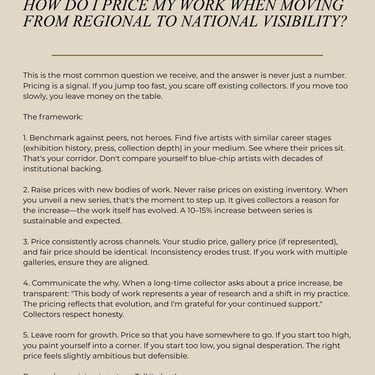
Question 2: How do I price my work when moving from regional to national visibility?
This is the most common question we receive, and the answer is never just a number. Pricing is a signal. If you jump too fast, you scare off existing collectors. If you move too slowly, you leave money on the table.
The framework:
1. Benchmark against peers, not heroes. Find five artists with similar career stages (exhibition history, press, collection depth) in your medium. See where their prices sit. That's your corridor. Don't compare yourself to blue-chip artists with decades of institutional backing.
2. Raise prices with new bodies of work. Never raise prices on existing inventory. When you unveil a new series, that's the moment to step up. It gives collectors a reason for the increase—the work itself has evolved. A 10–15% increase between series is sustainable and expected.
3. Price consistently across channels. Your studio price, gallery price (if represented), and fair price should be identical. Inconsistency erodes trust. If you work with multiple galleries, ensure they are aligned.
4. Communicate the why. When a long-time collector asks about a price increase, be transparent: "This body of work represents a year of research and a shift in my practice. The pricing reflects that evolution, and I'm grateful for your continued support." Collectors respect honesty.
5. Leave room for growth. Price so that you have somewhere to go. If you start too high, you paint yourself into a corner. If you start too low, you signal desperation. The right price feels slightly ambitious but defensible.
Remember: pricing is a story. Tell it clearly.